Land record correction: fixing errors in a khatauni or jamabandi
Last reviewed:
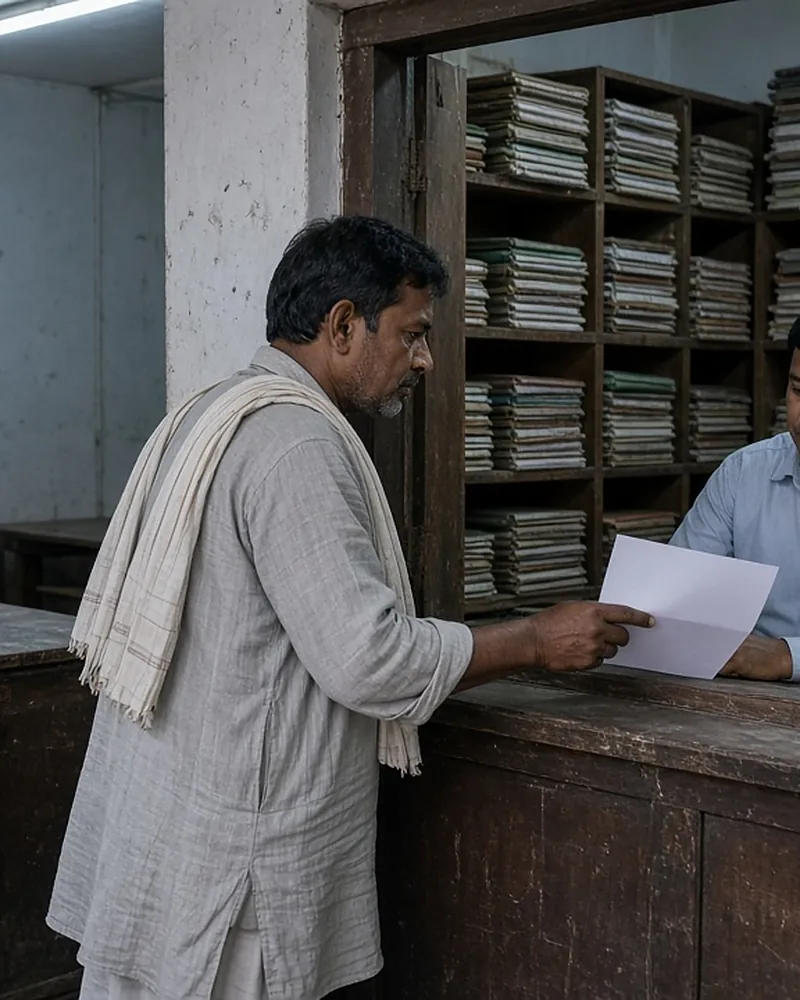
Mistakes in land records are common. Names were copied by hand for decades, records were typed into computers in a hurry during digitisation, and shares and areas were sometimes carried forward wrongly from one settlement to the next. Typical errors are a misspelt name or father’s name, a wrong share between co-holders, a plot number or area entered wrongly, a plot missing from a holding, or a whole jamabandi missing from the online register.
Each state has a formal route to correct such errors. It always runs through the revenue officers, never through the search screen of the portal, and it always needs evidence. A correction route is meant for errors and omissions. It does not decide who owns the land when that is disputed: title disputes go to the competent revenue or civil court, and the record is then corrected to follow the court’s order.
Errors you can correct, and what needs another route
| Problem | Route | Who decides |
|---|---|---|
| Clerical error in name, parentage, share or area | Correction application | SDM or circle officer after inquiry |
| Error in the village map | Correction application | Collector in UP |
| Sale or inheritance not yet recorded | Mutation (dakhil-kharij) | Tahsildar or circle officer |
| Dispute over who owns the land | Suit before the revenue or civil court | The court |
| Forged or manipulated entry | Correction application; entry can be expunged in UP | SDM or Collector |
If the problem is that a recent sale or death has not been recorded, the answer is mutation, not correction.
Uttar Pradesh: section 38 correction
Section 38 of the Uttar Pradesh Revenue Code, 2006 covers the correction of any error or omission in the map, the khasra (field book) or the khatauni (record of rights).
- Apply to the Tahsildar. The application for correction is made to the Tahsildar of the tehsil, in the prescribed manner. The Tahsildar can also act on an error that comes to notice otherwise.
- Inquiry and reference. The Tahsildar makes the inquiry needed and sends the case with a report to the Collector if it is a map correction, or to the Sub-Divisional Officer (SDM) for any other correction.
- Decision. The Collector or SDM decides after considering objections and evidence filed before them or before the Tahsildar.
- Appeal. Anyone aggrieved can appeal to the Commissioner within 30 days of the order. The Commissioner’s decision is final, subject to section 210 of the Code.
Two further provisions matter in practice. Under section 38(5), a forged or manipulated entry in the map, khasra or khatauni can be expunged under the same section. Under section 38(6), the Revenue Inspector can correct an undisputed error or omission in the khatauni or khasra after the prescribed inquiry, which is the quickest route for a simple mistake. Section 36(2) adds that no correction under section 38 is recorded until the land revenue due on the land has been paid.
Revenue court cases in UP, including correction cases, can be followed on vaad.up.gov.in, which has a case search and a plot-wise search. For a problem with the UP Bhulekh website itself, rather than the record, the Board of Revenue’s computer cell lists 0522-2217144, and complaints can be registered on the state’s Jansunwai portal.
Map errors in UP
The Bhu-Naksha UP portal states that if a plot’s area on the map differs from its khatauni, the khatauni area is treated as authentic, and that a landholder can apply to the court to correct an area error in the map. Under section 38 a map correction is decided by the Collector. If the issue is where the boundary lies on the ground rather than how it is drawn, a measurement (paimaish) under section 24 can be applied for on vaad.up.gov.in.
Bihar: Parimarjan Plus
In Bihar, errors in the digitised jamabandi shown on Bihar Bhumi are corrected through Parimarjan Plus. The Bihar Bhumi jamabandi FAQ sorts corrections into four groups:
- Old digitised jamabandis. Errors made while digitising the paper registers: the raiyat’s name, father’s name, caste or address; the khata, khesra, boundaries or area, or their absence; and the rent amount and year. Apply on Parimarjan Plus with evidence; the circle officer corrects the entry after inquiry. The procedure is in departmental letter 1426(9) dated 05.06.2024.
- Jamabandis created by online mutation. Name errors or omissions of buyer, seller or raiyat, and rent and boundary errors, are corrected on application through Parimarjan Plus under letter 597(9A) dated 01.03.2025. Khata, khesra and area errors after online mutation form a third category.
- Jamabandi entered in the wrong mauza. Where a jamabandi of one mauza was put online under another, or jamabandis of two or more mauzas were put online under one, the application is made offline to the circle officer, under letter 168(9) dated 20.01.2025.
- Missing jamabandi. If your jamabandi has been running and you pay rent but it is not online, apply on Parimarjan Plus to have it digitised; the circle officer inquires and puts it online under letter 2153(9) dated 08.08.2024.
The circulars are available in the circular section of the revenue department’s website, and Parimarjan Plus carries the detailed application steps.
Other states' correction services
| State | Where | Service |
|---|---|---|
| Andhra Pradesh | Meebhoomi | Mutation for correction |
| Kerala | Ente Bhoomi | Co-relation correction where the digital survey recorded the old survey number wrongly |
| Punjab | Punjab Land Records | Grievance redressal |
| Haryana | Revenue office | Corrections after upload only through the prescribed official procedure |
| Andaman and Nicobar | Dweep Bhoomi | Record correction service |
Haryana’s press release of 27 July 2026 on certified copies makes the patwari or revenue official responsible for the correctness of uploaded records and says any correction after upload goes through the prescribed procedure. Elsewhere, apply to the tehsildar, circle officer or taluka office with the evidence, and check whether your state land-record portal has a grievance or correction option in its services menu.
Documents that help
- an older certified copy of the khatauni, jamabandi or khatiyan showing the correct entry
- the registered sale deed, gift deed, partition deed or court order behind the entry
- the death certificate and family details for an inheritance entry
- land revenue receipts showing the correct name and khata
- identity documents showing the correct spelling of the name and parentage
- for area or boundary errors, the village map and, if available, a measurement report
Before you apply, open the current record on the portal and save it, so that you can show exactly which entry is wrong. An apparent area error in a khasra and khatauni or a jamabandi is sometimes just a holder’s share being read as the whole plot, so work out the share first.
After the correction
Once the order is passed, ask for a copy of it and keep it with your land papers. Then open a fresh copy of the record on the portal and confirm that the change has been made exactly as ordered, including the spelling and the share. Corrections are entered by the revenue staff after the order, so allow some time before checking. If the record still shows the old entry weeks later, take the order to the tehsil or circle office. Banks, buyers and scheme offices will rely on the corrected online record, so it is worth confirming before you need it.
FAQ
Can I correct my name in the khatauni online?
In UP the correction application goes to the Tahsildar; undisputed errors can be corrected by the Revenue Inspector. In Bihar the application is made online on Parimarjan Plus.
How long does a correction take?
It depends on the inquiry and on objections. Simple undisputed errors move fastest. Keep the application number and follow the case on the state’s revenue court or correction portal.
What if the other co-holders object?
The officer hears the objection and decides on the evidence. If the dispute is really about title, the officer may leave it to a court.
Is there a fee?
Fees, if any, are set by each state. Pay only through the official portal or at the revenue office, and keep the receipt.