Khasra khatauni: what it shows and how to check it online
Last reviewed:
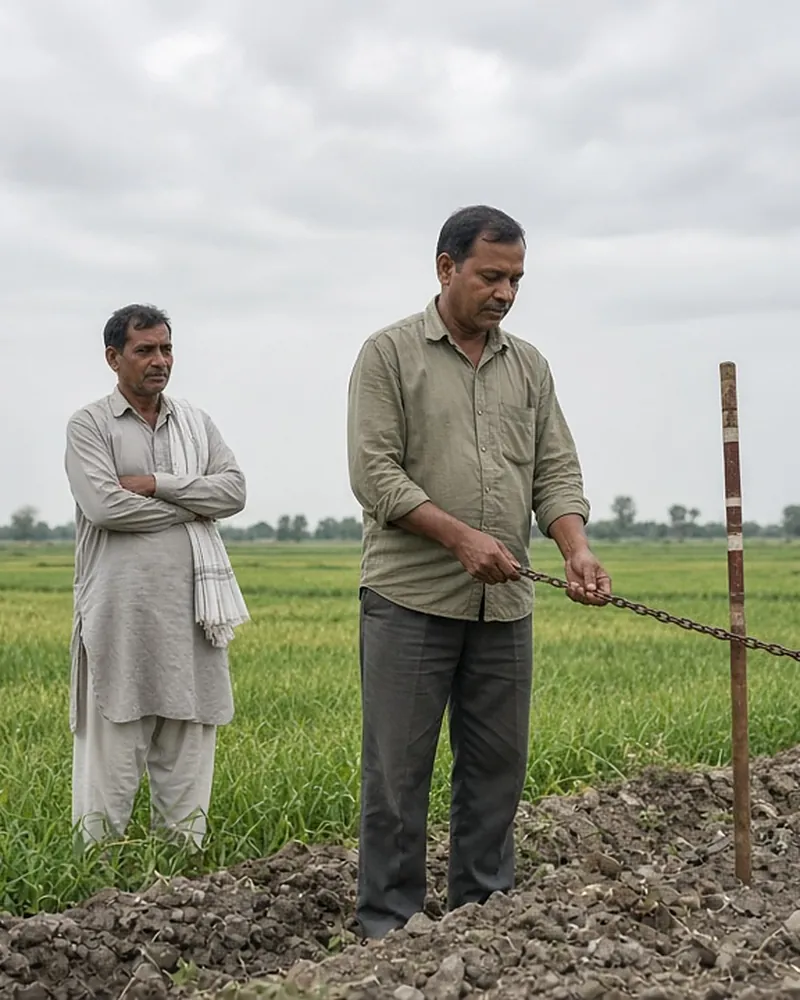
Khasra and khatauni are the two core land records of Uttar Pradesh, and the same names are used in Uttarakhand, Madhya Pradesh, Delhi and several other northern states. The khatauni is the record of rights: it lists who holds each holding, their shares and the plots that make it up. The khasra is the field book: it lists each plot by number with its area, class of land, crops and possession, season by season. The two are tied together by the plot number, which in UP is called the khasra number or the gata number.
In UP both are maintained by the lekhpal under the supervision of the Revenue Inspector and the Tahsildar. Section 31 of the Uttar Pradesh Revenue Code, 2006 requires a record of rights (khatauni) for every village, and section 32 keeps the khasra and the village map in step with it.
Khatauni, khasra and khata in plain words
- Khata number: the account number of one holding. One khata can contain several plots, and one plot can be shared by several holders in the same khata.
- Khasra or gata number: the number of a single plot. The Glossary of Revenue Terms published by the Department of Land Resources calls the gata number the primary identifier for land in a UP khatauni; it is the plot number used after consolidation (chakbandi).
- Fasli year: the revenue year, running from 1 July to 30 June. Khatauni and khasra entries carry a fasli year rather than a calendar year. Fasli 1433, for example, began in July 2025.
- Uddharan khatauni: the extract of the khatauni shown online. The glossary describes it as a non-certified copy for reference and preliminary checks; legal and official work needs a certified copy.
What a UP khatauni extract shows
The glossary reproduces the UP khatauni format. Its main fields are:
| Field | What it tells you |
|---|---|
| Extract number, village code and name, tehsil, district | Which village record the extract comes from |
| Fasli year and section (bhag) | The revenue year and the part of the khatauni |
| Khata number and category (shreni) | The holding and the kind of tenure, such as bhumidhar with transferable rights |
| Tenure holder details | Name, father’s, husband’s or guardian’s name, address and, for minors, date of birth |
| Khasra or gata number with unique code | Each plot in the holding |
| Area in hectares and share | Total area of each plot and each holder’s share in it |
| Land revenue | Revenue payable on the holding |
| Order details | The court or office, case number and date of the order behind each entry, such as a mutation |
| Mortgage status | Whether a plot is mortgaged to a bank or society, or released |
Areas in a UP khatauni are recorded in hectares. Because many buyers and sellers still talk in bigha or biswa, converting the hectare figure correctly matters; the land area converter uses only official factors.
How to view a khatauni on UP Bhulekh
The khatauni copy on UP Bhulekh is free and needs no login.
- Open upbhulekh.gov.in and choose “खतौनी (अधिकार अभिलेख) की नक़ल देखें” (view a copy of the khatauni) from the भूलेख सेवाएं (Bhulekh services) menu.
- Choose the district (जनपद), then the tehsil and the village. The district list has all 75 districts in English and Hindi.
- Search by khasra or gata number, khata number or the holder’s name, using whichever option the search screen offers. The plot number gives the most reliable match.
- Pick the right entry from the results and open the khatauni. Check the fasli year printed on it.
- Print or save it for your own reference. For official use, order a certified copy.
From the same portal you can also check whether a plot has been sold and whether it is under litigation. The home page links the unique gata code of a plot to its litigation status, sale status, map and mutation register.
Finding the record without numbers
If you do not know the khata or gata number, search by the holder’s name, trying the spelling in Hindi as the record writes it. A family’s old receipt for land revenue, a previous khatauni copy, a sale deed or a bank loan paper usually carries the khata and gata numbers. The lekhpal of the village can also give them. If a plot was split or renumbered during consolidation, the old number will not match; the tehsil can tell you the new gata number.
Khasra and the e-Khasra portal
The UP khasra is now kept on the e-Khasra portal at ekhasra.up.gov.in, where the lekhpal records crops and possession each season. On 20 November 2026 it showed entries for fasli 1431, 1432 and 1433 as open and fasli 1430 as closed. The khasra matters when you need proof of who is cultivating a plot or what is grown on it, for example for crop insurance or a crop loan.
Khatauni in other states
| State | Record | Where to view it |
|---|---|---|
| Uttarakhand | Khatauni, with a separate kshatavarshik khatauni for land under the zamindari abolition law | Bhulekh Uttarakhand |
| Madhya Pradesh | Khasra and B-1 khatauni | MP Bhulekh |
| Chhattisgarh | B-1 kistabandi khatauni and P-II khasra | Bhuiyan |
| Delhi | Khasra-khatauni (Form P-6) and jamabandi | Indraprastha Bhu-Lekh |
In Madhya Pradesh, plain copies of the current khasra, B-1 khatauni and map are free, and certified copies cost ₹10 per page under CM Jan Seva (181). Chhattisgarh’s Bhuiyan counter showed 2,54,92,006 khasras on 20 November 2026, of which 2,40,37,123 carried a digital signature. Haryana, Punjab, Himachal and Rajasthan keep a jamabandi nakal instead of a khatauni, and Bihar, Odisha and Jharkhand a khatiyan; each of them runs its own state portal.
Land area converter
Enter an area and pick the units, and the converter gives the result with the source of every factor it used. It works with square metres, ares, hectares, acres, square yards (gaj), square feet, decimals (dismil), cents and guntha, plus the state units for which the Glossary of Revenue Terms gives an official value: the Assam bigha (14,400 sq ft), katha and lessa, and the Haryana kanal (one-eighth of an acre). It accepts Hindi unit names such as हेक्टेयर, एकड़ and बीघा, and Devanagari digits.
For a UP, Bihar or Rajasthan bigha, biswa or katha it gives no figure. The glossary records that these units differ so widely that their conversions are non-standard even within a state, so any single figure would be wrong for many villages. Use the hectare figure printed on the khatauni, or ask the tehsil for the local value.
| Unit | Equals | Source |
|---|---|---|
| 1 hectare | 10,000 sq m, or about 2.4711 acres | Glossary of Revenue Terms, Gujarat section |
| 1 acre | 4,046.86 sq m, or 4,840 sq yd, or 43,560 sq ft | Glossary of Revenue Terms, Jharkhand and Haryana sections |
| 1 decimal (dismil) | 1/100 acre, about 40.47 sq m | Glossary of Revenue Terms, Bihar and Jharkhand sections |
| 1 cent | 1/100 acre | Glossary of Revenue Terms, Kerala section |
| 1 guntha | 1/40 acre, about 101.17 sq m; local definitions vary | Glossary of Revenue Terms, Gujarat section |
| 1 kanal (Haryana) | 605 sq yd; 8 kanals make an acre | Glossary of Revenue Terms, Haryana section |
| 1 bigha (Assam) | 14,400 sq ft; about 7.47 bigha to a hectare | Glossary of Revenue Terms, Assam section |
| Unit | Square metres | Source |
|---|---|---|
| square metre | 1 | GoRT p.28 (Assam: 1 centiare = 1 sq m); p.77 |
| are | 100 | GoRT p.77 (Gujarat): 1 Are = 100 square meters |
| hectare | 10,000 | GoRT p.77 (Gujarat): Hectare = 10,000 square meters |
| acre | 4,046.86 | GoRT p.105 (Jharkhand): 1 Acre = 4046.86 sq. meters; p.86 (Haryana): 1 acre = 4840 sq. yards |
| square yard (gaj) | 0.836127 | GoRT p.86 (Haryana): 1 acre = 4840 sq. yards |
| square foot | 0.092903 | GoRT p.86 (1 acre = 4840 sq yd) with 1 sq yd = 9 sq ft |
| decimal (dismil) | 40.4686 | GoRT p.37 (Bihar) and p.105 (Jharkhand): 1 decimal = 1/100 acre |
| cent | 40.4686 | GoRT p.130 (Kerala): 1/100th of an acre, 40.468 square meters |
| guntha (gunta) | 101.1714 | GoRT p.77 (Gujarat): 1 Guntha = 1/40 acre, but local definition may vary |
| kanal (Haryana) | 505.8571 | GoRT p.86 (Haryana): 1 kanal = 605 sq. yards and 1 acre = 8 kanals |
| bigha (Assam) | 1,337.8 | GoRT p.28 (Assam): 14,400 sq ft = 1 bigha (Manual of Mensuration and Surveying for Mandals and Patwaris in Assam, 1900) |
| katha (Assam) | 267.5608 | GoRT p.28 (Assam): 2,880 sq ft = 1 katha |
| lessa (Assam) | 13.378 | GoRT p.28 (Assam): 144 sq ft = 1 lessa |
Viewing copy versus certified copy
The free khatauni extract is enough to check names, shares, plot numbers and areas. For a bank loan, a court case, a registration or a government scheme, you will usually need a certified copy. UP Bhulekh offers a certified khatauni through its online payment service, which needs a login; the fee is shown at the payment step. A certified copy can also be obtained through the tehsil.
If what you see is wrong, a correction goes to the Tahsildar under section 38 of the Revenue Code, and the Sub-Divisional Officer decides; the appeal against that decision lies to the Commissioner within 30 days, and undisputed errors can be fixed by the Revenue Inspector (record correction). If the entry is out of date because a sale or inheritance has not yet been recorded, that is a matter for mutation. The same gata number identifies the plot on the village map, which shows its shape and its neighbours.
Common mistakes when reading a khatauni
- Reading a share as the whole plot. Where several holders share a khata, each holder’s share is a fraction of the plot area. Multiply the plot area by the share to get the holder’s area.
- Using an old extract. An extract from an earlier fasli year may not show a recent sale, inheritance or court order. Check the fasli year and open a fresh copy before relying on it.
- Matching by name only. Names repeat within villages and spellings differ. Always confirm the gata number and the father’s or husband’s name.
- Ignoring the mortgage column. A plot pledged to a bank or cooperative society shows a mortgage entry until it is released.
FAQ
What is the difference between khasra and khatauni?
The khasra describes each plot: its number, area, land class, crops and possession. The khatauni describes each holding: who the holders are, their shares and which plots they hold. You find a plot in the khasra and its holders in the khatauni.
Is khasra number the same as gata number?
In UP, yes for practical purposes. Gata number is the term used after consolidation, and the UP khatauni shows it as “khasra/gata number” with a unique code.
Why is my khatauni area in hectares?
UP records areas in hectares. Convert to acres (1 hectare is about 2.4711 acres) or to square feet with the converter. Local bigha values vary, so no official bigha figure exists for UP.
How often is the khatauni updated?
Entries change whenever a mutation, correction or court order is carried out. The extract shows the fasli year and the order details behind each change.